
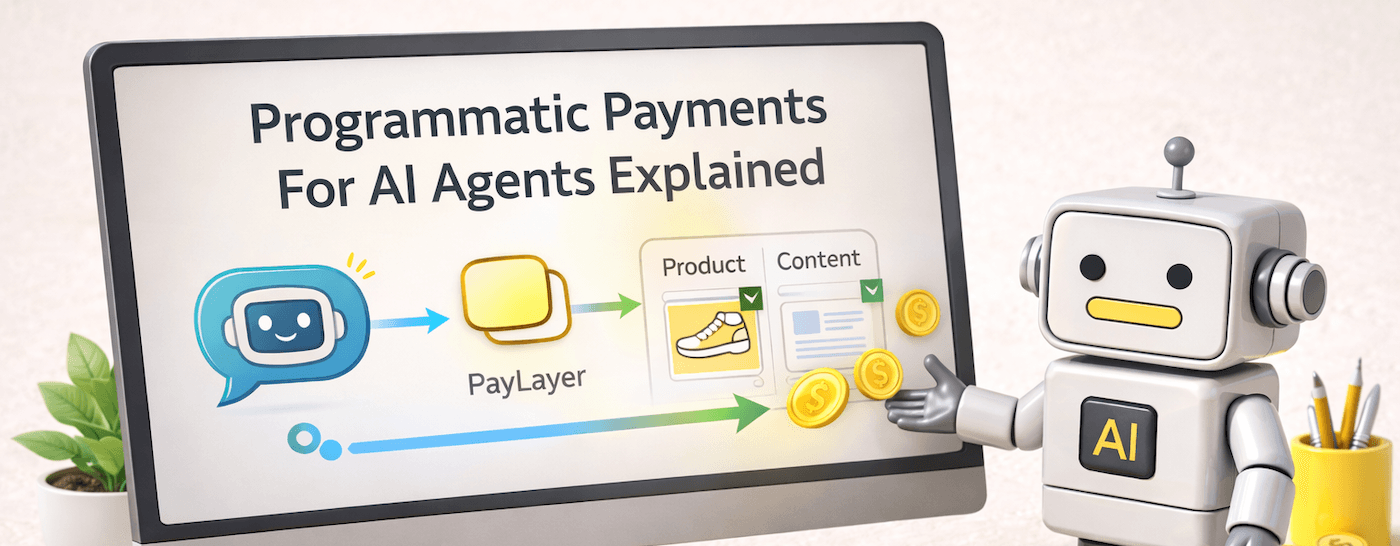
Picture an AI assistant trying to read a paywalled article. No credit cards. No forms. It just pays on its own, instantly, and gets in. That’s programmatic payments in action: software sending money directly to other software, without a person clicking “buy” or typing details.
With programmatic payments, software checks the price, pays, and unlocks access automatically. Think of a tiny cashier inside the machine world that knows the steps and runs them fast. An AI research bot might spend 25 cents on one article and finish the whole thing in under two seconds.
This doesn’t replace normal online shopping. It runs alongside it, quietly, without changing websites or the way people browse. We’ll explore more detailed examples of how machine-to-machine payments differ from traditional checkout later. For now, imagine money moving between digital helpers out of sight, fast and direct.
How machine payments differ from human checkout systems
- Human checkout flows revolve around user steps. Shopping cart, login, forms, and security hurdles like 3D Secure or email codes. Software skips the fuss. Stateless APIs publish prices and access rules, then other systems call them without a back-and-forth.
- Identity is central in consumer checkout. Names, addresses, and payment details reduce fraud and route the package. Machine payments swap personal data for cryptographic keys and digital signatures. These prove authority while hiding who’s behind the request.
- Patience is different. People wait ten seconds, maybe a minute, before they get restless. AI agents want sub-second price checks and payment confirmations within two or three seconds to keep workflows from timing out.
- Humans recover from errors by retyping or trying again. Software needs precise signals. Clear codes like 402 Payment Required or 409 Conflict explain the failure. Idempotency keys prevent double charges during retries.
- Pricing diverges. Shoppers favor bundles or subscriptions for simplicity. Software prefers granular billing by API call, byte, time, or task. Costs stay tightly controlled.
How AI pays for products and content with the request, pay, access loop
An AI agent wants to buy a digital product or unlock content. The flow looks like online shopping, only it runs end to end without clicks: request, pay, access. Fast loop, tight controls.
- The AI agent requests a resource, for example an article or a software feature.
- The server replies with a price and terms, including cost, currency, and usage limits.
- The agent pays through a machine-focused payment protocol.
- After payment clears, the server verifies the proof and returns the content or a token for access.
Price quotes carry more than a number. They include a unique fingerprint for the exact item, such as a hash. They state currency per unit or task. They expire after a set time so stale offers don’t linger, and they also include replay protection so cached quotes stay safe from fraud or duplication.
Fulfillment has options. A server can stream the content back to the agent. It can return pre-signed URLs that expire. It can issue capability tokens scoped to a specific resource and valid for a short window. Tight scope keeps permissions contained.
Security sits at the center. Each payment ties cryptographically to the resource it covers, so swapped proofs don’t pass. Old proofs get rejected on sight. Capability tokens enforce least privilege. Agents receive only what they paid for.
Observability backs the whole system. Every quote, every payment, each fulfillment gets logged with correlation IDs. Operators audit transactions and pull revenue insights without hassle.
X402 protocol for machine payments and interoperable AI commerce
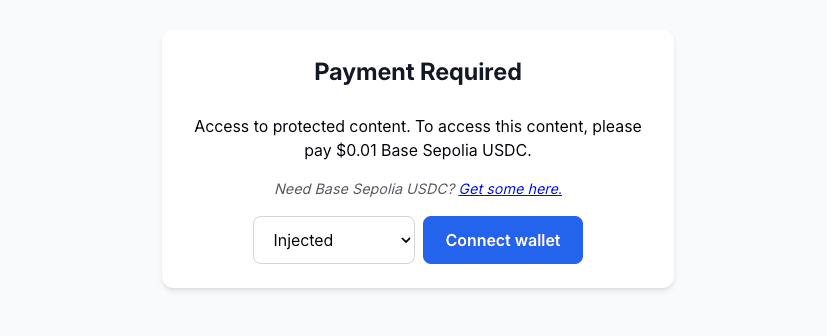
X402 is a machine payments protocol built for AI-first transactions. It uses the 402 Payment Required signal in a format software can read instantly. Agents see when to pay, how much to pay, and how to confirm payment without human steps.
The protocol relies on a few concrete components. Price endpoints show the cost. Payment instructions tell where and how to send funds. Signed receipts or proofs confirm it’s done. Standard response codes report success or failure with no guesswork. Systems talk the same way and avoid mix-ups.
Interoperability is the headline. Agents from different vendors work with any merchant that follows the spec, with no custom code for each new site. It’s plug-and-play across the web, which cuts engineering time and opens more places where AI assistants can buy.
Real-world results back it up:
- Tens of millions of dollars move each month across many merchants
- Settlement signals arrive near instantly, so workflows stay fast
- The network scales as demand grows without stalls
Developers get solid guidance. The spec at x402.org explains the model in detail, plus deterministic tests and sandbox environments to surface edge cases early. Conformance checks confirm integrations act the same way every time before launch, which builds trust in production machine payments.
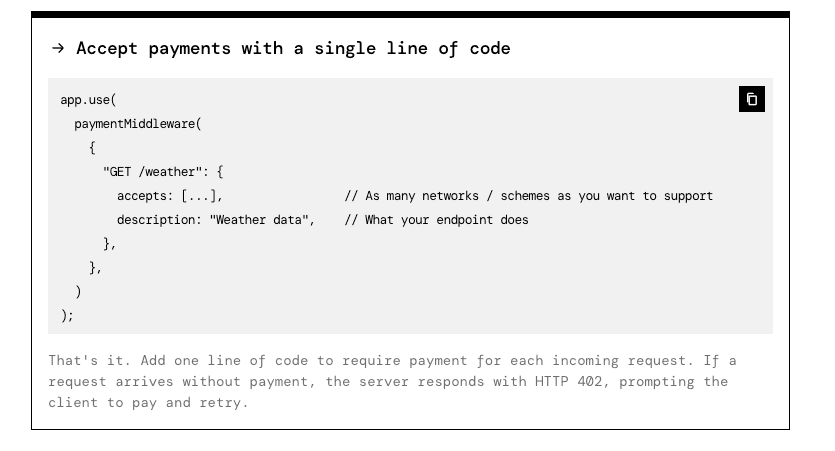
PayLayer adds machine payments without changing your frontend
PayLayer sits between a website and machine payments. It speaks the x402 protocol so AI agents pay without touching the normal human checkout. WooCommerce, Stripe, and PayPal keep working as they always have.
Setup stays simple. A server plugin registers digital goods, prices, and terms for articles, APIs, or product SKUs. These map to site URLs or product IDs behind the scenes. No redesign. No new pages. The existing structure stays in place so machines know what to buy and where to send payment.
Human visitors see the same site. No extra buttons, no pop-ups. Agent traffic goes to separate endpoints. AI agents get 402 price quotes and clear payment steps on their own lane, while people browse as usual.
After payment, PayLayer verifies proof, then issues access tokens or pre-signed links to the purchased content. Each transaction gets written back to the app for clear records of who paid and for what.
It’s built for tiny transactions, from pennies to a few dollars. Bursts of agent activity get handled with rate limits and idempotency keys. That avoids overloads or double charges when many automated buyers show up at once.
Mapping the data flow from price quote to fulfillment
Programmatic payments run on a few clear data objects that keep things secure and predictable. A Quote spells out resource_id, price, currency, ttl, and a terms_hash that fixes the exact terms. When an agent pays, it submits a Payment with proof of payment, a payer_key for identity, the amount, and a reference to the quote. After settlement, the server issues a Receipt with a receipt_id, a signature to verify it’s real, and a settled_at timestamp.
Here’s the basic flow in practice:
- The agent asks for a resource with a GET request.
- The server answers with 402 Payment Required and includes the Quote.
- The agent sends a POST with the Payment details.
- The server returns 200 OK with the Receipt and an Access token.
- The agent presents the token and does a GET to retrieve the content.
Idempotency prevents double charges when networks misbehave or messages repeat. Clients attach an idempotency key to each payment. Servers store those keys and return the original receipt for repeats, which avoids duplicate processing.
Quotes expire fast, usually 30 to 120 seconds, so prices stay current. Servers allow small clock drift within a safe window, which reduces failures from minor timing gaps and cuts fraud risk.
Each step includes a correlation_id to tie logs across quotes, payments, and content delivery. Audits go faster, suspicious patterns stand out, and revenue tracking doesn’t get lost in scattered records.
Managing programmatic payouts with an application ledger
A digital ledger keeps every money move in one place. Each quote, payment, and fulfillment gets a permanent event ID. Publishers and merchants see which AI buyer purchased each asset and how much revenue each one brought in.
Small sales add up over time. Instead of paying out every single transaction, the system batches micro-transactions over days or weeks. Bulk payouts go to bank accounts or crypto wallets, which lowers fees and pays everyone on a steady schedule.
If access fails after payment, smart links tie the receipt back to the exact resource fingerprint. Refunds or access re-grants trigger automatically, which means fewer disputes and less back-and-forth.
Marketplaces benefit as well. When many sellers list in one storefront, the ledger tags sales with product IDs and splits revenue to the right parties. Each merchant sees their share without manual work.
Compliance stays clean with exports for accounting tools in CSV or JSON. The ledger stores currency, tax flags, and jurisdiction info for VAT or GST reporting so filings don’t spiral into chaos.
Programmatic payouts through an application ledger add clarity and trust to automated earnings, making it easier for publishers and merchants to track money across AI-driven sales.
Leave a Reply